
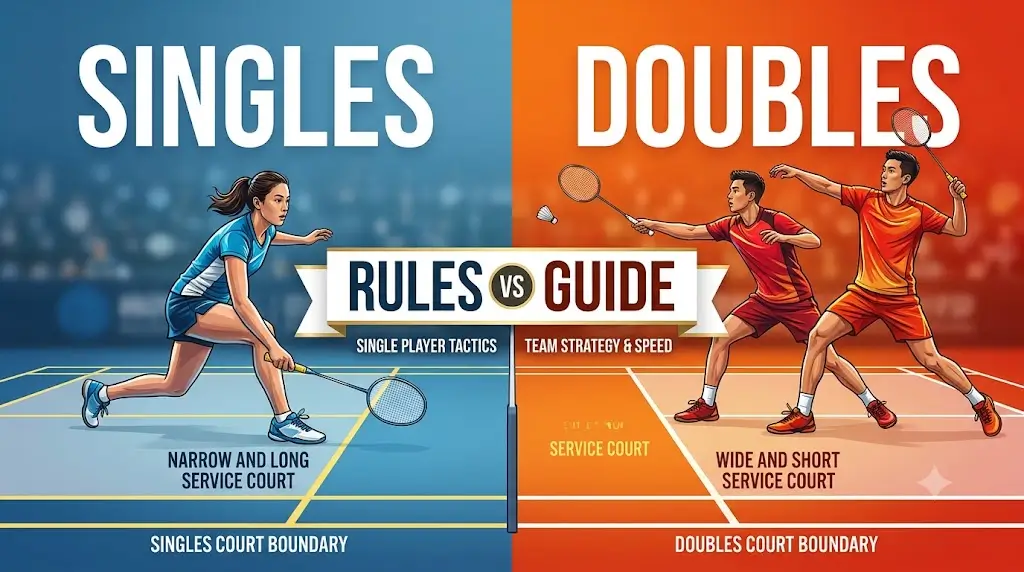
Badminton is one of the fastest and most dynamic racket sports in the world. While casual backyard matches are a great way to spend an afternoon, stepping onto a formal court requires a strict understanding of the official laws set by the Badminton World Federation (BWF).
To the untrained eye, singles and doubles matches look remarkably similar. However, they are governed by distinctly different rules regarding court boundaries, serving rotations, and positioning. Whether you are a beginner looking to play competitively or an experienced enthusiast brushing up on the latest regulations, this comprehensive guide breaks down everything you need to know about badminton singles and doubles rules.
1. Core Scoring System (Universal Rules)
| Rule Element | Key Regulation |
| Match Format | Best of 3 games |
| Target Score | 21 points per game |
| Scoring Method | Rally point system (point scored on every serve) |
| Tiebreaker | Must win by 2 points (deuce), capped at a maximum of 30 points |
Regardless of whether you are playing a singles or doubles match, the fundamental scoring engine remains identical. A standard match follows a best-of-three structure, meaning the first side to secure two complete games is declared the winner. Each individual game is a race to 21 points. Under the rally point system, a point is awarded on every single rally, meaning you do not need to be the server to score. If a game reaches a tight 20-20 tie, players must secure a clear two-point lead to win. However, to prevent matches from dragging on indefinitely, a hard cap is set at 30 points; if the score reaches 29-29, the player or team that scores the 30th point wins the game immediately.
2. Badminton Court Boundaries: “Long & Narrow” vs. “Short & Wide”
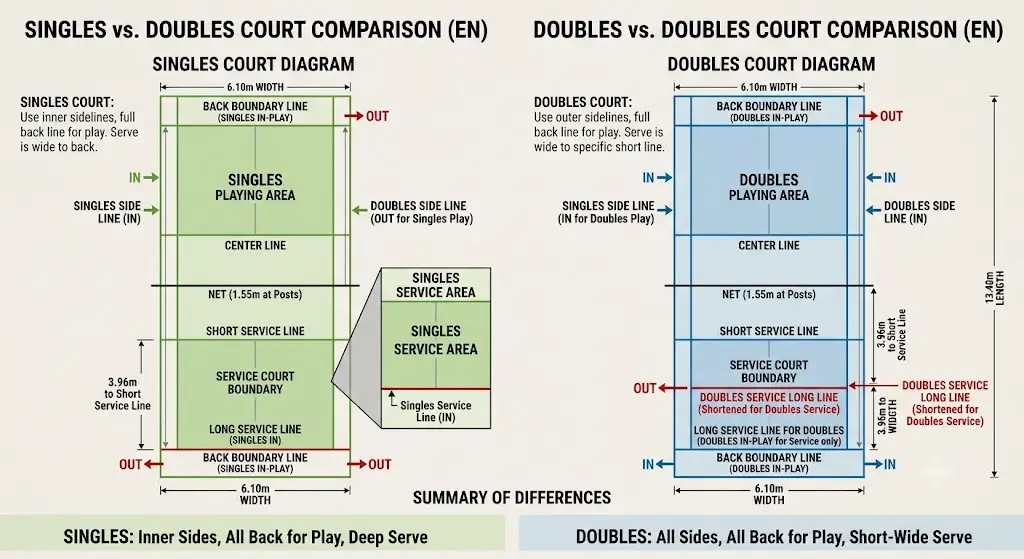
- Singles General Play: Inbounds within the inner side lines and outermost back lines (tramlines are out).
- Singles Service: Must land past the short service line and within the inner side lines, extending to the deepest back line.
- Doubles General Play: The entire wider court is active, including the side tramlines.
- Doubles Service: Wide but short; must land within the outer side lines but cannot pass the inner back service line.
Boundary Configurations Explained
While the physical court dimensions do not change, the actual boundaries in play shift drastically between formats. In singles, where one player must cover the entire floor, the court is designed to be narrow. The side tramlines are completely out of bounds during general play, and the service zone is long and thin, stretching all the way to the very back boundary line.
In contrast, doubles matches emphasize rapid-fire power and lateral coverage. Consequently, the entire width of the court is active during rallies, bringing the side tramlines into play. However, the service rules for doubles introduce a unique restriction: the service zone becomes wide but short. A serve must land within the wider outer side lines, but it is considered a fault if it sails past the inner back boundary line.
3. Serving and Court Position Regulations
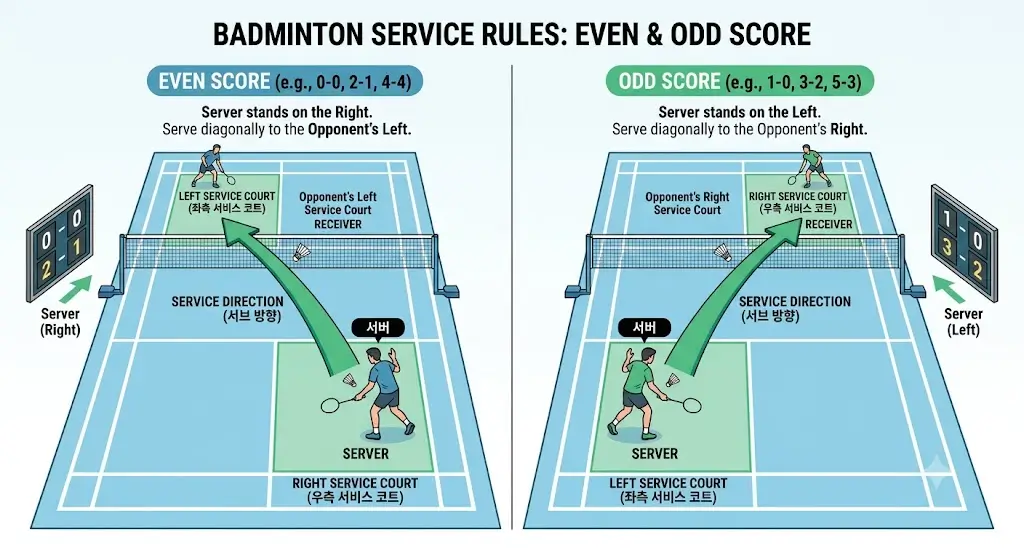
Right Service Court (Even Scores): Serves are delivered from the right side when the server’s score is 0, 2, 4, 6, etc.
Left Service Court (Odd Scores): Serves are delivered from the left side when the server’s score is 1, 3, 5, 7, etc.
Position Swapping (Doubles Only): Partners only switch left/right physical boxes when they win a point on their own serve.
Serving Mechanics and Positioning
Positioning in badminton is completely dictated by whether the current server’s score is even or odd. In singles, this is highly intuitive: a player serves from the right-hand court when their score is even, and from the left-hand court when their score is odd, with the receiver mirroring their position diagonally across the net.
Doubles serving follows the same even-odd court rule, but introduces strict positioning guidelines to coordinate four players. When the serving side wins a rally, they earn a point and the same server switches to the alternate service box to serve to the other opponent. However, if the receiving team wins a rally, they win a point and the service rights, but no physical positions are swapped. The new server is decided solely by the receiving team’s current score: if their score is even, the player currently standing in the right box serves; if odd, the player in the left box serves.
4. Common Faults to Avoid
| Fault Type | Strict Violation Rule |
| Service Height | Shuttlecock must be below $1.15\text{ meters}$ from the ground at impact |
| Net Touch | No part of the body, clothing, or racket may touch the net during play |
| Over the Net | Players cannot strike the shuttlecock before it crosses to their side |
| Double Hit | The shuttlecock cannot be hit twice consecutively by a player or team |
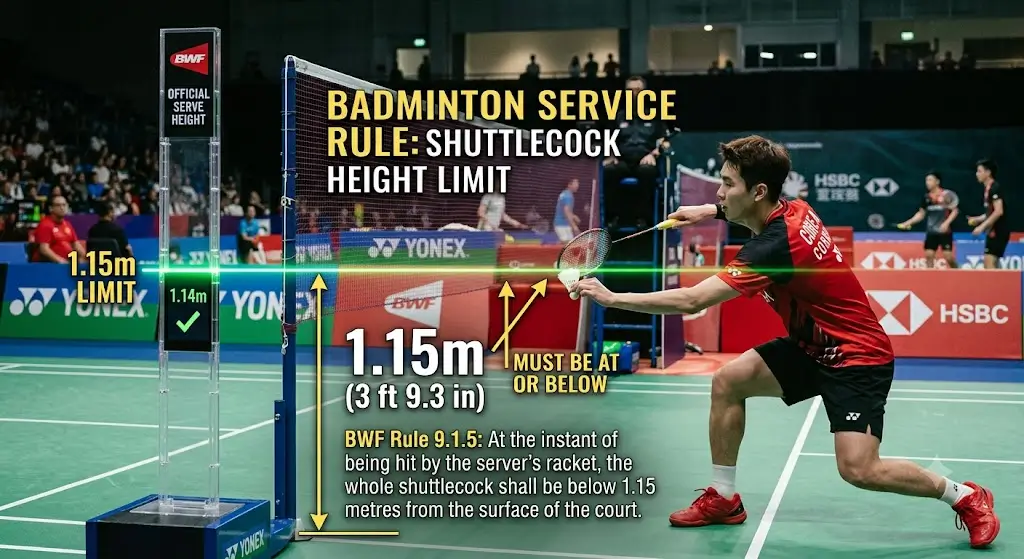
To maintain fair play and competitive integrity, players must actively avoid committing technical faults, which result in an immediate point and loss of serve to the opponent. The most scrutinized violation is the service height fault, which requires the shuttlecock to be struck below a height of 1.15 meters to prevent aggressive downward serving. Additionally, players must keep their distance from the net; touching the net or its posts with your body, clothing, or racket while the rally is active is a major violation. You must also wait for the shuttlecock to physically cross the plane of the net before striking it, and ensure that the shuttlecock is hit cleanly in a single stroke, as double hits by a single player or consecutive hits between doubles partners are strictly illegal.
Conclusion & Next Steps
Mastering the rules of singles and doubles is the first major step toward enjoying badminton at a competitive level. However, understanding the laws of the game is only half the battle—having the right equipment to execute your shots is just as critical.
Now that you know how the game is played, check out our comprehensive guide on How to Choose Your First Badminton Racket: A Beginner’s Guide to find the perfect gear for your playing style.