
Stepping into the world of badminton is an exciting journey filled with fast rallies, tactical clears, and powerful smashes. However, walking into a sports store or browsing online as a beginner can quickly become overwhelming. The market is flooded with countless racket models, boasting advanced technologies, varying weights, and intricate specifications.
Choosing the wrong racket early on can hinder your skill development and, worse, lead to painful injuries like tennis elbow. Your first racket needs to be a supportive tool that complements your learning curve. This comprehensive guide breaks down the essential technical aspects of selecting your very first badminton racket, ensuring you make an informed decision that elevates your game.
1. Racket Weight and Grip Size (The Fundamentals of Handling)
| Specification | Optimal Choice for Beginners |
| Weight Classification | 3U (85–89g) or 4U (80–84g) |
| Grip Size | G4 or G5 (Smaller sizes for better finger control) |
When selecting your first racket, the physical weight and the thickness of the handle are the most critical factors governing your comfort on the court. Badminton racket weights are globally classified using a “U” system, where a lower number signifies a heavier racket. Beginners should generally avoid heavy 2U rackets and ultra-light 5U models. A 3U or 4U racket provides the ideal baseline, offering enough mass to generate natural power behind your clears without placing excessive structural stress on your underdeveloped wrist and forearm muscles.
Concurrently, grip sizes are denoted by a “G” system, which operates inversely: a higher number means a smaller handle circumference. Opting for a G4 or G5 size is highly recommended for beginners because a smaller handle allows for better finger leverage and maneuverability. You can always easily customize a small grip by adding an inexpensive overgrip to match your exact hand size, whereas a handle that is initially too thick cannot be altered.
2. Shaft Flexibility and Balance Point (Determining Your Playstyle)
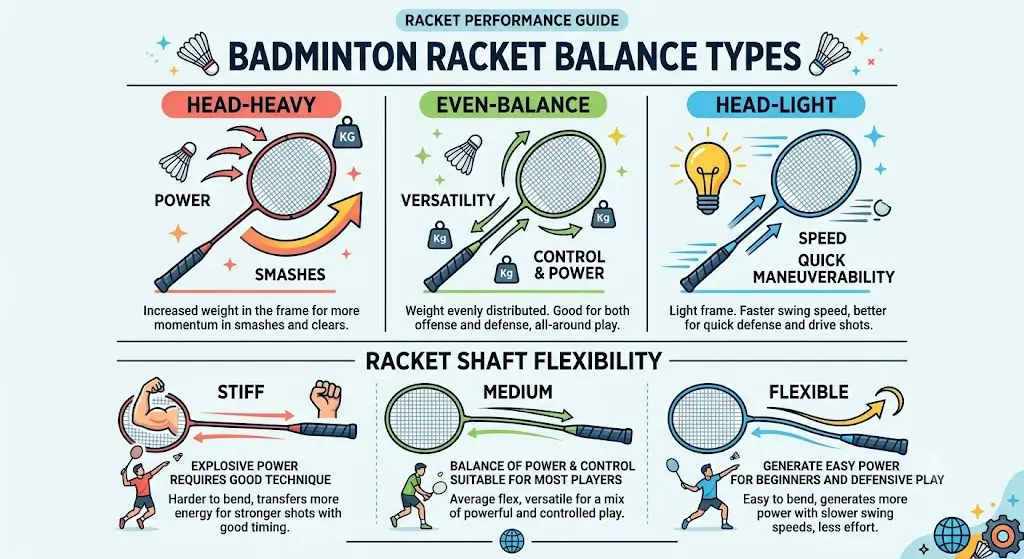
- Flexible Shaft: Provides a trampoline effect, generating easy power for clearing from baseline to baseline.
- Stiff Shaft: Offers maximum control and precision but requires excellent wrist technique and high swing speed.
- Head-Light Balance: Enhances racket speed and defense, ideal for quick net play and fast-paced drives.
- Head-Heavy Balance: Shifts the weight to the top of the frame, amplifying smash power at the cost of speed.
- Even Balance: The perfect middle ground, distributing weight uniformly for an all-around playstyle.
Understanding Shaft Flex and Racket Balance
The flexibility of the racket shaft dictates how energy is transferred from your swing to the shuttlecock. Beginners almost universally benefit from a flexible or medium-flex shaft. When you swing a flexible racket, the shaft bends and snaps back at impact, creating a natural whipping action that injects extra power into your deep backcourt clears. Stiff shafts do not bend easily, meaning all the power must come entirely from your own perfect technique and explosive wrist speed—something beginners are still developing.
Alongside flexibility, the balance point defines where the center of gravity lies along the racket. A head-heavy racket acts like a hammer, making your smashes incredibly heavy but slowing down your defensive reactions. A head-light racket moves swiftly through the air for defense but requires more physical effort to clear deeply. Therefore, an even-balance racket is the ultimate choice for a novice, offering a balanced, neutral platform to master both offensive and defensive strokes smoothly.
3. String Tension and Construction Material
Graphite or Carbon Fiber: Premium, lightweight materials that offer superior vibration absorption and structural durability.
Aluminum or Steel: Budget-friendly but heavy and rigid materials that lack the responsiveness needed for proper skill progression.
Low String Tension (20–24 lbs): Expands the sweet spot and provides effortless power, making it forgiving for off-center hits.
High String Tension (25+ lbs): Shrinks the sweet spot but increases control, requiring precise, advanced ball-striking skills.
Stringing and Material Considerations
The overall construction material of the racket frame shapes how much vibration travels up your arm upon impact. You should strictly look for rackets constructed from 100% High Modulus Graphite or Carbon Fiber composites. Avoid cheap steel or aluminum frames often found in recreational backyard sets; they are far too heavy, unforgiving on the joints, and do not flex dynamically.
Once you have a graphite racket, the final piece of the puzzle is string tension, measured in pounds (lbs). It is a common mistake for beginners to mimic professional players by stringing their rackets at high tensions. High tension tightens the string bed like a wooden board, leaving zero room for error and requiring flawless hitting accuracy. For your first racket, keeping the string tension low, specifically between 20 to 24 lbs, is highly advised. This lower tension creates a highly responsive, forgiving “sweet spot” that naturally launches the shuttlecock further, reducing the physical strain on your arm as you focus on perfecting your form.
Conclusion & Next Steps
Finding the right weight, flexibility, and string tension will give you a massive advantage as you start your badminton journey. A well-suited graphite racket will not only prevent injuries but also help you develop the correct muscle memory and technique much faster.
Now that you know how to choose the perfect gear, it’s time to understand how the actual game is played on the court. Before your first match, make sure to read our Complete Guide to Badminton Singles and Doubles Rules to master the boundaries, scoring, and positioning.