
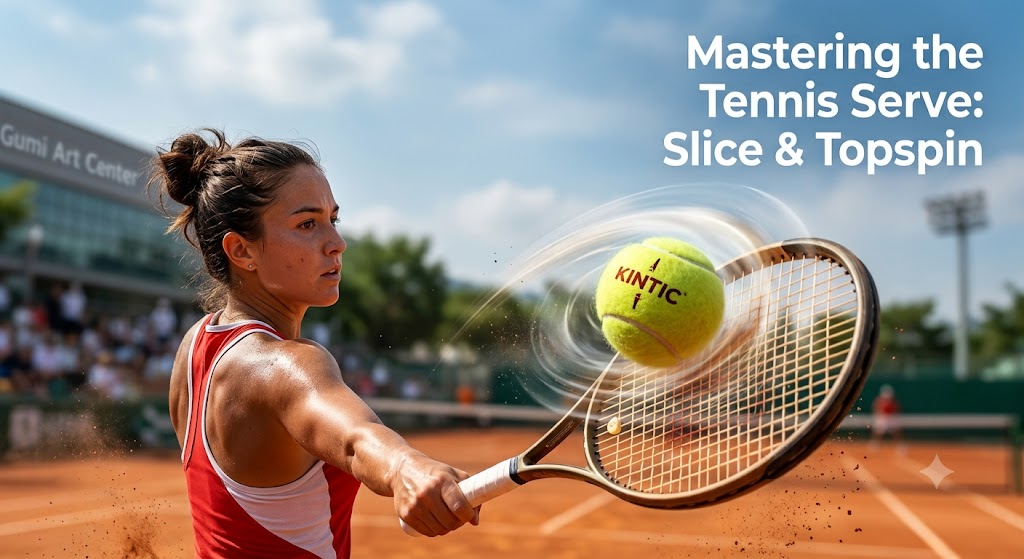
The serve is arguably the most critical stroke in tennis because it is the only shot entirely within your control. While a flat, powerful first serve can earn free points through aces, relying solely on raw speed is a risky strategy. Against skilled returners, variety, placement, and heavy rotation are far more devastating weapons.
Mastering spin serves—specifically the slice and the topspin (or kick) serve—allows you to dictate the rhythm of the match and protect your service games. These spin variations force your opponent out of their comfort zone by changing how the ball moves through the air and behaves after hitting the court surface. This comprehensive guide breaks down the mechanics, racket paths, and technical execution needed to add these two essential variations to your serving arsenal.
1. The Slice Serve (The Art of Lateral Movement)
| Technical Element | Key Mechanical Adjustment |
| Grip Type | Continental Grip (Base knuckle on bevel 2) |
| Ball Toss | Slightly to the right (for right-handers), around 1 or 2 o’clock |
| Racket Path | Left-to-right brushing motion across the outside of the ball |
| Tactical Use | Widening the court on the Deuce side, jamming the body on the Ad side |
The slice serve is defined by its dramatic lateral curving motion through the air and its low, skidding bounce upon hitting the court. To execute this shot effectively, you must utilize a standard Continental grip, which allows your wrist to snap naturally and pronate through contact. Unlike a flat serve where the ball is tossed directly in front, the toss for a slice serve should be slightly to the right (around 1 or 2 o’clock for a right-handed player) and a bit lower.
The magic of the slice happens during the contact phase. Instead of hitting through the back of the ball, your racket face travels along a distinct left-to-right path, brushing across the outer right equator of the ball. This side-spin creation causes the ball to curve sharply away from right-handed returners on the Deuce court, dragging them completely off the singles sideline and opening up the entire court for an easy second-shot winner.
2. The Topspin Kick Serve (The Bounce That Defies Gravity)
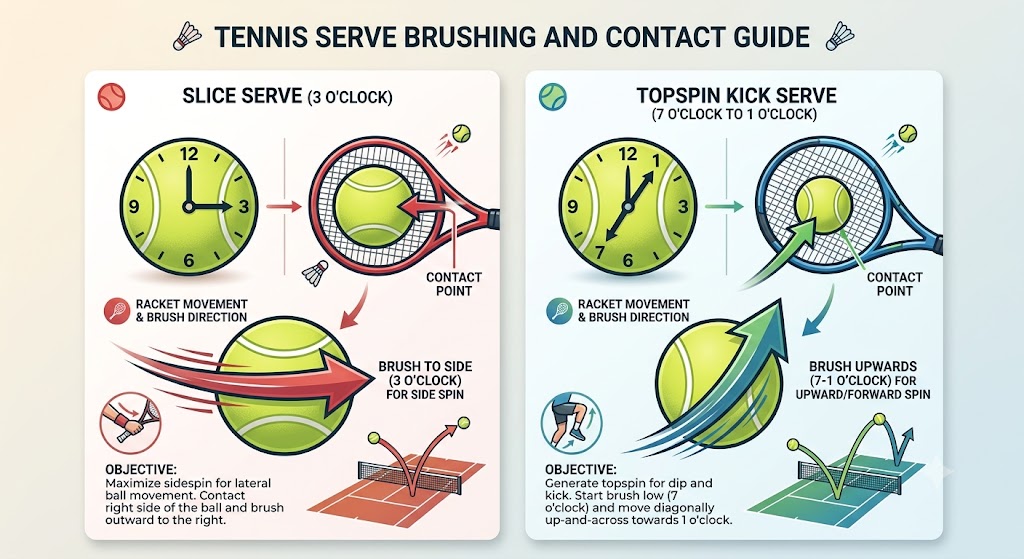
- 12 o’clock Ball Toss: The ball is thrown slightly backward and directly above or slightly behind the head.
- Upward Racket Path: The string bed brushes the ball from low-to-high, moving from 7 o’clock to 1 o’clock.
- Explosive Leg Drive: Maximum knee bend is required to launch upward into the contact point.
- High Clearance & Deep Bounce: The heavy topspin creates a safe net clearance followed by an aggressive, high-jumping trajectory.
Mechanics of the Topspin Kick Serve
While the slice serve focuses on horizontal movement, the topspin or kick serve utilizes vertical rotation to maximize safety and create an unpredictable, high bounce. The technical execution begins with a specialized ball toss that goes slightly behind your head, around the 11 or 12 o’clock position. This unique placement forces you to arch your back slightly and drop the racket head deeply into a “scratch-your-back” position behind your shoulders.
As you unleash your upward swing, the racket travels on a steep low-to-high trajectory, brushing the back of the ball from bottom-left to top-right (envisioning a clock face, brushing from 7 o’clock to 1 o’clock). This rapid upward friction generates massive forward and diagonal rotation. When the ball crosses the net, the aerodynamic force of the topspin pulls it down sharply into the court, ensuring high net clearance and minimal errors. Upon bouncing, the ball suddenly explodes upward and outward, jumping toward the receiver’s backhand shoulder and forcing them into an incredibly awkward hitting position.
3. Pronation, Wrist Snap, and Tactical Execution
Continental Grip Mastery: The non-negotiable foundation that enables effortless wrist pronation and snap at the peak of the swing.
Disguised Ball Toss: Keeping the initial toss trajectory similar to prevent the returner from reading your serve variation early.
Targeting the Backhand: Utilizing the kick serve to constantly attack the opponent’s weaker wing, especially on crucial second serves.
The Body Jam Option: Slipping a heavy slice serve directly into the returner’s hip or chest to completely neutralize their swing space.
Advanced Fluidity and Placement Strategy
To truly elevate your spin serves, you must focus on the seamless combination of body mechanics and tactical deception. Wrist pronation is the ultimate mechanical secret; it is the natural outward rotation of the forearm and wrist at the exact moment of contact that accelerates the racket head to its maximum speed. Without proper pronation, your spin serves will lack the bite and velocity needed to trouble advanced opponents.
Furthermore, high-level tactical execution relies heavily on disguise. If you change your body positioning or toss the ball too obviously to the side, a smart returner will instantly anticipate the spin and adjust their positioning. Your goal should be to keep your service motion identical until the final millisecond before contact, keeping the opponent guessing whether a flat blast, a curving slice, or a jumping kick serve is headed their way. By varying these spots—using the slice to pull them wide and the kick to jam them high—you can comfortably control the match from your very first shot.
Conclusion & Next Steps
Mastering the slice and topspin kick serves will give you complete control over your service games, keeping your opponents constantly off-balance. Deception, placement, and heavy rotation are the ultimate keys to becoming a dominant server.
Now that you know how to conquer the outdoor tennis court, why not explore the fast-paced world of indoor racket sports? Check out our next comprehensive guide, Squash vs. Racquetball: Understanding the Key Differences, to discover how these indoor disciplines can sharpen your reflexes and overall athleticism.