
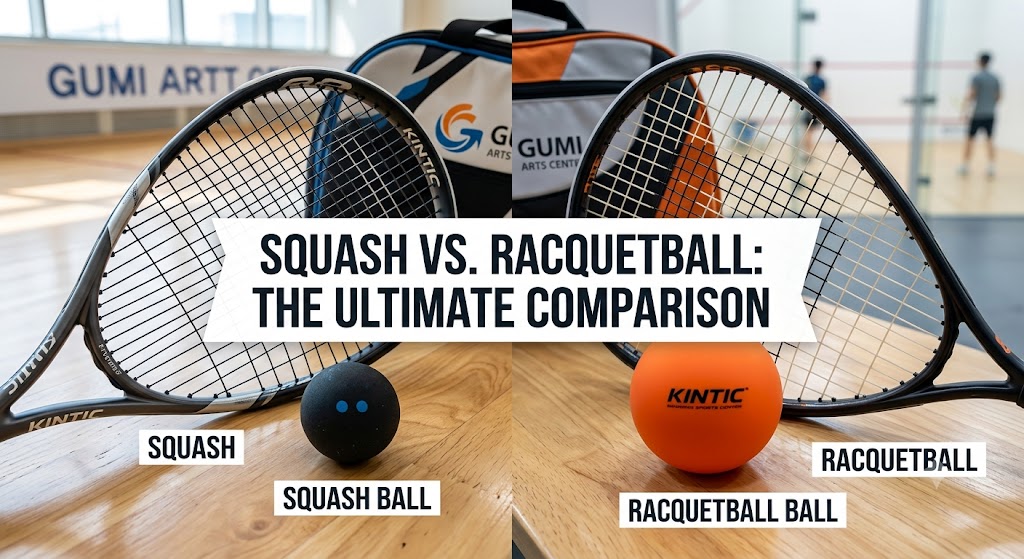
For those stepping inside an indoor racket sport court for the first time, squash and racquetball can look deceptively identical. Both sports feature two players enclosed in a four-walled room, swinging rackets and sprinting after a fast-moving ball. However, assuming they are the same sport is a major misconception.
From the physical layout of the court to the engineered bounce of the ball, squash and racquetball demand completely different athletic skill sets, strategies, and physical mechanics. Understanding these nuanced distinctions is crucial whether you are looking to take up a new hobby, improve your court movement, or simply appreciate the tactical depth of indoor sports. This guide breaks down the core structural, equipment, and rule variations that define these two fast-paced disciplines.
1. Court Dimensions and Environmental Boundaries
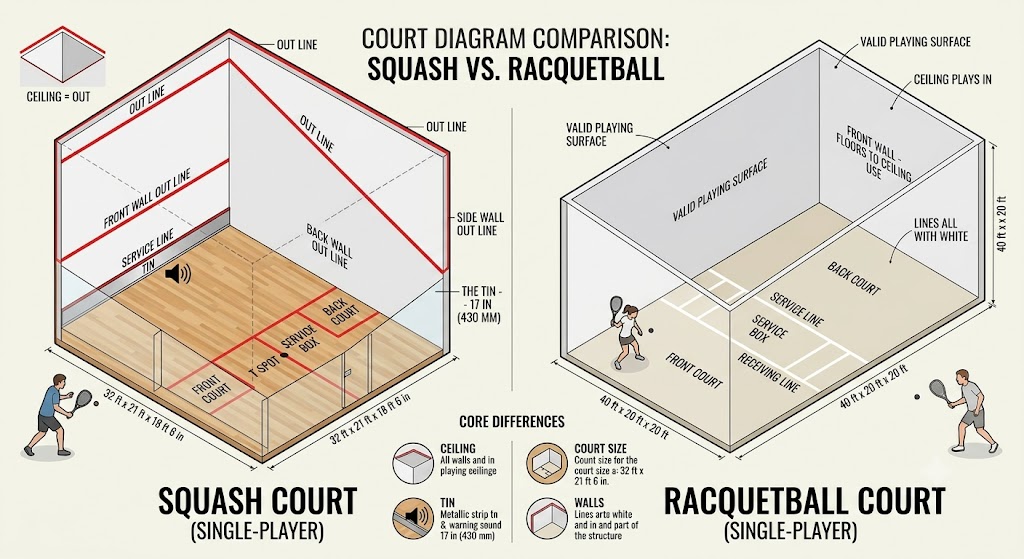
| Feature Component | Squash Regulation | Racquetball Regulation |
| Court Size | Smaller and narrower (32ft long x 21ft wide) | Larger and longer (40ft long x 20ft wide) |
| Ceiling Boundary | Out of bounds (completely invalid surface) | In bounds (fully playable surface during rallies) |
| Front Wall Tin | Mandatory 17-inch metal barrier at the bottom | None (playable all the way down to the floor) |
The court environments of these two sports dictate entirely different styles of play and spatial awareness. A squash court is shorter but slightly wider, measuring 32 feet long and 21 feet wide, with a distinctive 17-inch metal barrier called the “tin” fixed to the bottom of the front wall. If a player strikes the tin, the ball is dead, forcing squash players to always hit with an upward angle. Furthermore, the ceiling in squash is strictly out of bounds, marked by clear boundary lines painted high on the walls.
In sharp contrast, a racquetball court expands significantly to 40 feet in length and 20 feet in width, providing much more physical room to run. The most revolutionary difference, however, lies in the boundaries: in racquetball, there is no tin at the bottom of the front wall, meaning shots can skim a mere millimeter above the floor. Additionally, the ceiling is fully in bounds, allowing strategic players to hit massive, high-arching defensive lob shots that bounce off the ceiling to die in the back corners.
2. Equipment Specifications: Rackets, Balls, and Footwear
- Squash Rackets: Longer frames (up to 27 inches) with smaller, teardrop-shaped heads built for surgical accuracy.
- Racquetball Rackets: Shorter, teardrop or rectangular frames (up to 22 inches) with broad heads designed for maximum power.
- Squash Balls: Tiny, dense rubber balls that must be physically warmed up through hard hitting to achieve a consistent bounce.
- Racquetball Balls: Large, pressurized, highly elastic rubber balls that bounce aggressively right out of the box.
Gear Mechanics and Equipment Differences
The physical equipment used in each sport directly influences the speed and control players have over the rally. Squash rackets feature longer shafts that maximize reach, paired with relatively compact heads that emphasize touch, control, and tight corner placement. The balls used in squash are remarkably unique; made of raw rubber, they have virtually no bounce when cold. Players must repeatedly strike the ball against the wall during a pre-match warmup to heat the air inside, which finally activates its optimal elasticity.
Racquetball gear is engineered for raw velocity and explosive power. The rackets are noticeably shorter but feature a much wider, broader hitting surface, mimicking a paddle with strings. This allows players to generate rapid head speed in tight spaces. Combined with a racquetball ball—which is much larger, pressurized, and incredibly bouncy even at room temperature—the game transforms into an ultra-fast spectacle where the ball flies around the court with extreme momentum, requiring rapid reflexes to track.
3. Scoring Structures, Service Rules, and Strategic Playstyle
Point Accumulation (Squash vs. Racquetball): Squash matches use a Point-A-Rally system to 11 points, while Racquetball utilizes a side-out system where points can only be won by the server up to 15 points.
Service Requirements: Squash requires serving from designated service boxes into the opponent’s rear quarter, whereas Racquetball allows serving from anywhere within a central zone.
The Tactical Core: Squash is a game of attrition, patience, and exhausting lunges, while Racquetball is a game of explosive kill-shots and rapid reaction times.
Serving, Scoring, and Tactical Execution
The strategic mindset required to win matches varies wildly between squash and racquetball due to how they are scored and regulated. Squash operates on a modern point-a-rally system, meaning whoever wins the rally wins the point, regardless of who served, with games played to 11 points. The serve in squash is highly regulated: the server must keep at least one foot inside a small service box on the floor and hit the ball mid-air into the opposite back quarter of the court. Tactically, squash is a game of chess; players try to dominate the “T-Zone” in the center of the court, utilizing precise drops and deep rail shots to slowly wear down their opponent’s stamina through long, grueling rallies.
Racquetball embraces a more traditional “side-out” scoring system, where you can only score a point when you are the active server. If the receiver wins the rally, no point is awarded, and they simply win the right to serve, with games going up to 15 points. The serving process is much more liberal, allowing the server to stand anywhere inside a wide service zone spanning the middle of the court, drop-bouncing the ball before hitting it. Strategically, racquetball minimizes long rallies in favor of the “kill-shot.” Because there is no tin on the front wall, players constantly aim to hit the ball as low as possible to the ground, causing it to roll flat along the floor so it is physically impossible for the opponent to return.
Conclusion & Next Steps
Whether you prefer the chess-like endurance of squash or the explosive, high-velocity kill-shots of racquetball, both indoor sports offer an incredible workout and a test of rapid reflexes. Choosing the right discipline depends entirely on your personal playing style and fitness goals.
Now that you have a solid grasp of indoor court strategies, it’s time to take your skills out into the open air. To truly elevate your racket game, transition to the outdoor court and learn how to dominate your games from the very first shot by reading our guide on Master the Tennis Serve: Slice and Topspin Techniques.